



This is the third post in Certum Group's seven-part series bringing our Trade Secret Litigation Playbook to the blog. It draws on Part III of the Playbook, Before You File. Read or download the full Playbook here . The call usually comes from a sales leader, a head of engineering, or a chief of staff, and it usually starts the same way: "We think someone took X, and we think they took it to Y." What happens in the next three days is disproportionately important. The most expensive mistake in trade secret practice is waiting — every week that passes lets the defendant commercialize your advantage, and worse, lets the evidence quietly disappear. Slack messages, badge records, and git histories often sit behind auto-delete settings as short as ninety days. So before you do anything else, move to preserve. Here is what good early triage looks like. Issue a litigation hold — in writing, within 24 hours A written instruction to preserve any document, chat, email, calendar, or file relating to the possible misappropriation, sent to the full legal, HR, IT, and leadership teams. It should be specific enough to be useful, broad enough to catch the unexpected, and documented enough that you can produce it later. This is the single most important thing you can do in the first day. Lock down forensic images — and don't let internal IT do it Laptops, phones, and company devices belonging to any suspected party should be forensically imaged by an outside forensics firm, not wiped or "checked" by internal IT. Chain of custody matters, and internal teams generally cannot testify to it at trial. The right instinct is to image broadly and review narrowly: you can always decline to look at a device you preserved, but you can never go back for one that was reissued, wiped, or sold. And don't forget the non-obvious sources — personal cloud drives, USB connection histories, printer spooler logs, and screen-capture utilities are often where the decisive evidence actually lives. Extend retention on cloud and platform logs Have IT extend retention on the relevant accounts and export the log data — access logs, download histories, egress traffic — before anything rolls off. The forensic story of who did what, when, and with which file is usually more persuasive to a judge than any human witness. A download at 11:47 p.m. the night before a resignation is powerful evidence because of what the timing means. Do not tip off the adversary Resist the urge to confront the suspected employee, their new employer, or their counsel. Confrontation at this stage tends to accelerate deletion and pull communications behind privilege claims. A carefully timed cease-and-desist letter, sent after preservation is secure, is a very different move — and a far more effective one. Investigate under privilege Any investigation you run should be conducted under attorney direction, so that the work product is privileged and your witness interviews do not become admissions used against you later. This is not about secrecy for its own sake. It is about making sure the investigation helps your case rather than becoming evidence in it. Consider — but do not rush — the early public filing Ex parte seizure orders, temporary restraining orders, and preliminary injunctions all have their place, and an early injunction can be the single most valuable outcome in the whole case. 1 But these motions require a level of evidentiary support you rarely have on day three. It is almost always better to spend a week building the record than to file fast and lose the first motion, which hands the defendant a narrative and hands you a hole to climb out of. The triage checklist If you want a single page to keep by the phone, it looks like this: litigation hold issued in writing within 24 hours; outside forensics firm retained and imaging scheduled; cloud and platform log retention extended; a list of suspected individuals plus their managers and peers; a list of the specific secrets that may have been taken; copies of every NDA, employment agreement, and IP assignment covering them; a review of the last 90 days of their calendar for unusual patterns; and outside trade secret counsel engaged under privilege. Do the first 72 hours well and you preserve every option that follows — injunction, damages, settlement leverage. Do them poorly and you may spend the next two years litigating around evidence you could have saved in an afternoon. If you are in the opening days of a matter and want a fast, confidential read on what to do now versus later, that is exactly the conversation we have most often. Go deeper with the Playbook. This post covers one piece of a much larger picture. For the full framework — what the law requires, what a strong pre-filing case looks like, how damages experts value these matters, how counsel fee structures change your economics, and how litigation finance fits in — read Certum Group's Trade Secret Litigation Playbook , our field guide for business owners and the counsel who advise them: certumgroup.com/the-trade-secret-playbook . And if you are evaluating a live dispute — or simply want to pressure-test what a matter is worth and how it might be funded — get in touch. A confidential conversation with Certum is free and carries no obligation, whether or not you ultimately seek funding. Reach us at certumgroup.com/contact-us . Sources 1. The ex parte seizure procedure is authorized by the Defend Trade Secrets Act, 18 U.S.C. Section 1836(b)(2), and is available only in extraordinary circumstances.

This is the second post in Certum Group's seven-part series bringing our Trade Secret Litigation Playbook to the blog. It draws on Part II of the Playbook, Trade Secret Law in Plain English. Read or download the full Playbook here . Here is a statistic that surprises most executives: in federal trade secret cases that reach a verdict, plaintiffs win roughly 84% of the time. 1 That is dramatically better than the plaintiff win rate in commercial litigation generally. It does not mean every case is easy — the cases strong enough to reach a jury are a selected group — but it tells you something important about what happens when a well-built trade secret claim gets in front of a fact-finder: courts tend to enforce the rights the statute was designed to protect. So why do good claims still fail? Usually not at trial. They fail earlier, on assumptions the claim holder never stopped to test. In more than a decade of evaluating these matters, the same handful of misconceptions come up again and again. Here are six worth clearing up before they cost you a case. Myth 1: "It's only a trade secret if we stamped it CONFIDENTIAL." Marking helps, but it is not required. What matters is whether your overall secrecy program is reasonable under the circumstances — a holistic look at contractual, physical, and technical controls. A perfect stamp on an otherwise open system is worth less than a coherent program with a few gaps. Myth 2: "If part of it is public, none of it is protected." Courts routinely protect a combination of individually public facts when the particular combination delivers competitive advantage. The recipe can be assembled from ingredients anyone can buy. What you protect is the assembly. Myth 3: "Our employees signed NDAs, so we're covered." NDAs are a foundation, not a program. The full set of reasonable measures a serious claim holder is expected to have includes access controls, badging, egress monitoring, exit procedures, and technical segmentation. An NDA in the drawer and nothing behind it is exactly the gap a well-resourced defendant will press on first. Myth 4: "We didn't sue the last person who left, so it's too late now." Trade secret protection is evaluated case by case. Declining to act on one departure does not forfeit your rights as to the next one. Every matter stands on its own facts. Myth 5: "We're too small to enforce against a big company." This one gets the economics backwards. A well-funded claim against a large, solvent defendant is often easier to win — and easier to collect — than a disorganized claim against a small one. Resources can be added to a strong case; facts cannot be added to a weak one. The right capital partner exists precisely so that a smaller plaintiff can stand toe-to-toe with a much larger adversary and neutralize the outspend-them tactics that used to decide these fights. Myth 6: "It's just know-how — courts don't protect that." Courts protect integrated know-how constantly. The question is never whether know-how is capable of protection; it is whether you can identify it with enough particularity to describe what was taken. 2 That is the single most consequential early decision in the case, and it is the one most claim holders do not realize they are making when they plead "our proprietary software" instead of the specific, described combinations that actually give them an edge. The through-line Notice what these myths have in common: each one leads a claim holder to under-invest in a case that the numbers say is very winnable. The 84% figure is not a promise. It is an invitation to take the early work seriously — the secrecy program, the identification, the evidence — because that work is what turns a strong set of facts into a strong case. Get those right, and the law is on your side more often than in almost any other kind of commercial dispute. Go deeper with the Playbook. This post covers one piece of a much larger picture. For the full framework — what the law requires, what a strong pre-filing case looks like, how damages experts value these matters, how counsel fee structures change your economics, and how litigation finance fits in — read Certum Group's Trade Secret Litigation Playbook , our field guide for business owners and the counsel who advise them: certumgroup.com/the-trade-secret-playbook . And if you are evaluating a live dispute — or simply want to pressure-test what a matter is worth and how it might be funded — get in touch. A confidential conversation with Certum is free and carries no obligation, whether or not you ultimately seek funding. Reach us at certumgroup.com/contact-us . Sources 1. Stout, Trends in Trade Secret Litigation (2024), reporting an approximately 84% plaintiff-favorable outcome rate across 271 federal trade secret cases reaching a verdict since 2017. 2. Both the federal Defend Trade Secrets Act (18 U.S.C. Section 1836) and the state Uniform Trade Secrets Act define a trade secret as information that derives independent economic value from not being generally known or readily ascertainable, and that is the subject of reasonable measures to keep it secret.
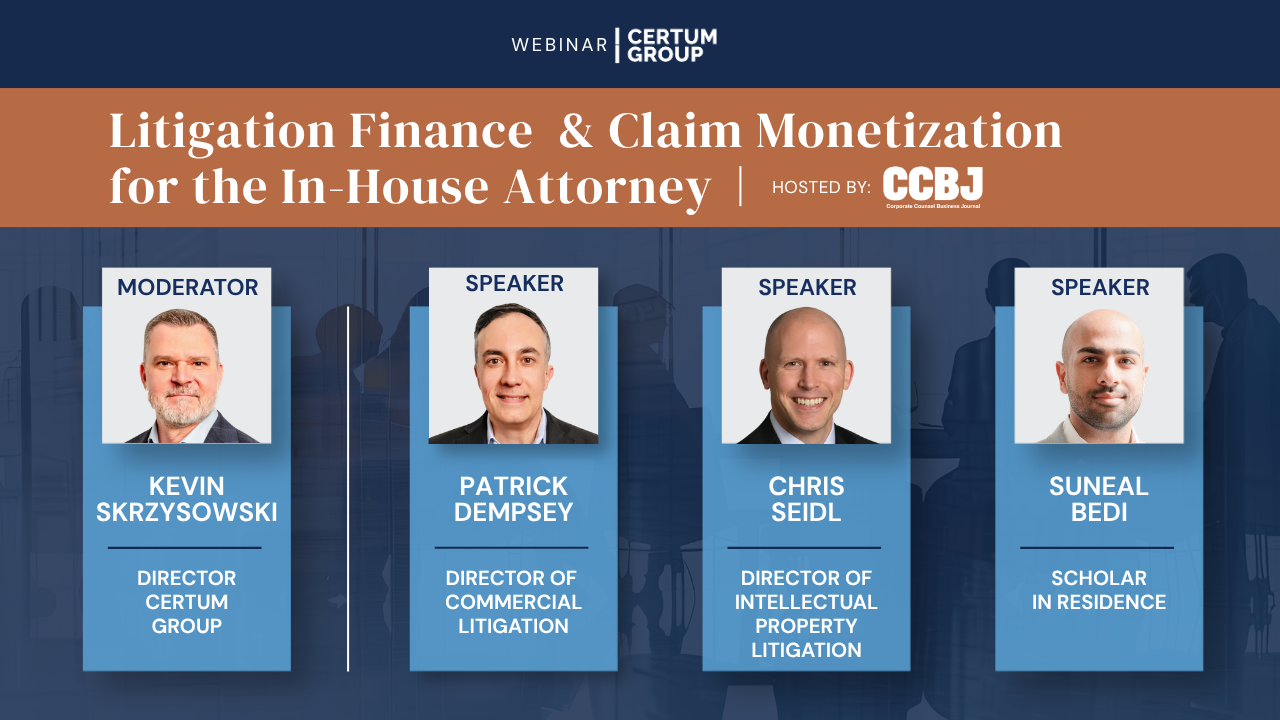
For most companies, the legal department is viewed purely as a cost center—a line item to be managed and minimized. But many organizations are sitting on significant, unrealized value in the form of affirmative claims: lawsuits they could bring against suppliers, vendors, or competitors who have breached a contract, stolen trade secrets, infringed intellectual property, or otherwise caused recoverable damages. All too often these valuable claims go unpursued because litigation is expensive, unpredictable, and competes with the business for budget and headcount. Certum Group, in conjunction with the Corporate Counsel Business Journal, created this one-hour webinar to show in-house counsel how litigation finance changes that calculus— allowing companies to pursue meritorious claims with little or no out-of-pocket cost and on a non-recourse basis, so the downside risk shifts to the funder while the company retains the upside. Our panel brought together leaders in commercial litigation, intellectual property litigation, and legal academia and demystified how litigation finance works and walked through practical, real-world uses for the corporate legal team. We also took a close look at claim monetization: the ability to receive cash today against the value of a pending or contemplated claim, rather than waiting years for a judgment or settlement. Monetization can take the form of an upfront advance secured by the expected recovery, or an outright sale of the claim to a specialized organization that then prosecutes the case and collects the judgment. Attendees left with an understanding of when litigation finance and monetization make sense, how to evaluate and pitch a case, what to expect from the process, and how these tools can transform the legal department from a cost center into a genuine contributor to the bottom line. Watch the full webinar replay HERE . Supporting Materials: Litigation Finance Guide In-House Survey Research Brief Trade Secrets Playbook