

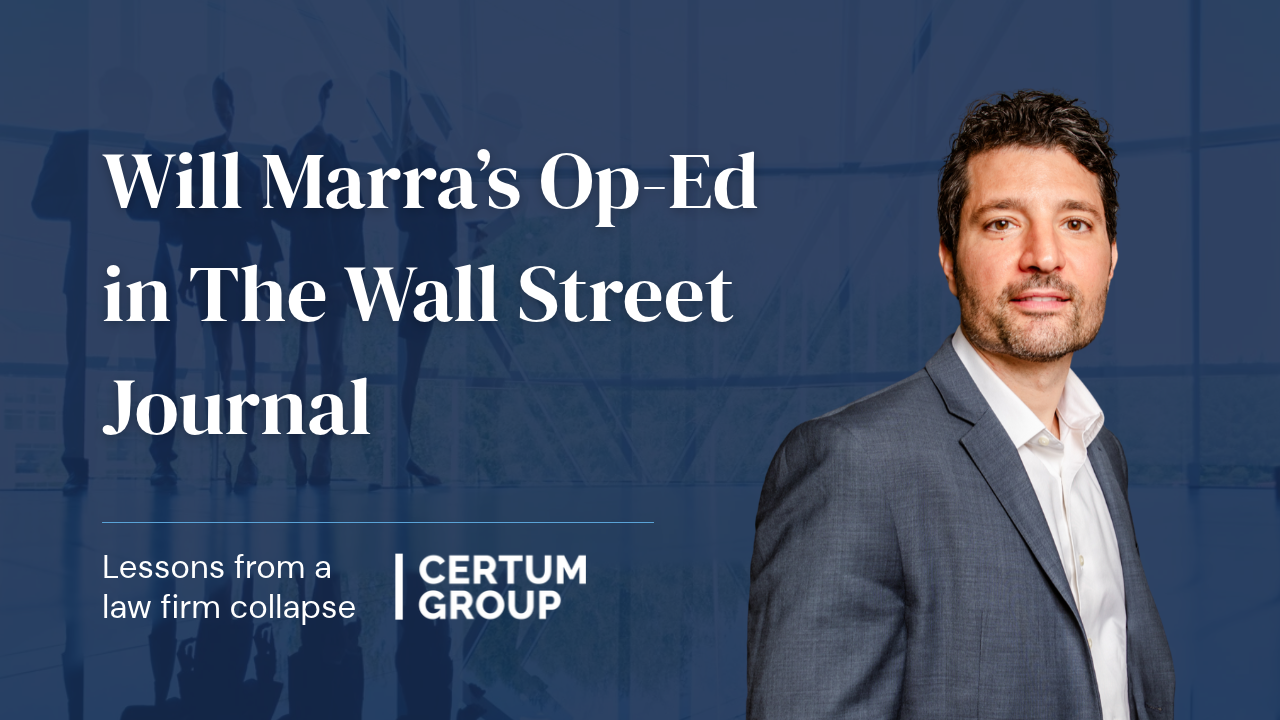
Certum’s Will Marra published an op-ed in yesterday’s Wall Street Journal drawing lessons from the recent collapse of Weil Gotshal for broader debates about third-party litigation funding and outside investment in law firms. Marra builds on scholarship by John Morley of Yale Law School, who has demonstrated that two legal ethics rules can contribute to the swift collapse of law firms. Those rules are Rule 5.4, which bars non-lawyer investment in law firms, and Rule 5.6, which bars non-competes for lawyers. Marra argues that these two rules affect every firm every day, by making it harder for them to make long-term investments that could reduce the cost of legal services, improve client service, and benefit the civil justice system. Marra suggests that reforming Rules 5.4 and 5.6 could not only help prevent the sudden collapse of the Weils of tomorrow but also improve the legal system writ large. The article is available at this link . For some of Will’s other commentary on litigation finance and the civil justice system, please see the article Litigation Finance in the Market Square , which was co-authored with Certum’s Scholar in Residence, Suneal Bedi , and was published last year by the Southern California Law Review.

This is the fifth post in Certum Group's seven-part series bringing our Trade Secret Litigation Playbook to the blog. It draws on Part V of the Playbook, Choosing Counsel and Structuring the Economics. Read or download the full Playbook here . The most common mistake I see claim holders make is also the most understandable one: they sign a law firm to a full contingency before they ever talk to a funder. A firm offering to take the whole case on contingency feels like a gift. You spend nothing, the firm carries the risk, and you share the upside only if you win. What could be wrong with that? When you look at cases side by side, quite a lot. A claim holder who engages a funder first and then hires counsel on a hybrid structure typically keeps substantially more of the recovery. To see why, start with the three ways to pay for a case. The three fee structures Hourly is the traditional model: you pay standard rates as the work is done, you own the outcome, and you bear 100% of the cost, win or lose. It fits deep-pocketed companies that want complete control, and smaller matters where alternative structures are hard to price. Full contingency puts the firm's fees entirely at risk, paid only from the recovery, usually at 33% to 40% of whatever comes in. It is attractive when you have limited capital, and the willingness of a good firm to take it is a genuine signal of merit. But it carries a real cost: that 30-to-40-percent-plus is meaningfully more than the combined economics of a hybrid or funded structure. Hybrid — shared risk — is the sweet spot for most matters between roughly $10 million and $250 million. The firm discounts its hourly rate, often steeply, in exchange for a smaller contingent premium on success. It preserves alignment while avoiding the full-contingency tax, and it becomes especially powerful when a funder pays the discounted fees, the claim holder pays nothing out of pocket, and counsel keeps meaningful upside. Why sequence changes the outcome Here is the part that sounds counterintuitive until you run the math. A 33-to-40-percent contingency leaves you with 60 to 67 cents of every recovery dollar. A hybrid structure — where counsel takes a smaller contingency, often 15 to 25 percent, layered on a discounted hourly fee that a funder pays — frequently leaves the claim holder with 50 to 65 percent after the funder's return, and sometimes more. The precise economics depend on the size and shape of the case, but the direction is robust: full contingency is rarely the cheapest path for a strong claim. Sequence matters because leverage is perishable. Once you sign a full-contingency engagement letter, the firm has effectively "bought" the case for its own investment committee, and switching firms afterward is expensive and awkward. With a funder in place and a hybrid structure available, you keep your optionality — you can hire the very best trial firm for your matter, rather than the best firm that happened to be willing to shoulder full risk. A funder's "no" is also valuable There is a quieter benefit, too. When a sophisticated institutional investor is willing to deploy non-recourse capital against your claim, that is one of the strongest external validations of case quality you can get, and counsel reads it that way. But even a decline is useful: it tells you where the weaknesses are — thin damages, a collectability problem, an identification gap — while you can still fix them, and before you have committed to a firm. Either way, you learn something you would rather know now than a year in. The sequence to consider In practice it looks like this. Retain trade secret counsel on a focused, limited-scope engagement to run an initial case assessment under privilege. While that is underway, open a confidential conversation with one or more funders, sharing the same materials. Use the funder's view — its willingness to fund, its read on damages, its suggested economics — to inform your choice of trial counsel. Then interview firms with that information in hand and propose a hybrid structure supported by the funder. Done well, the engagement letter, the funding agreement, and your preservation protocols can all be signed within the same week. None of this is a knock on contingency counsel, many of whom are excellent. It is simply a reminder that the cheapest-looking option at signing is often the most expensive one at resolution — and that a short conversation, before you sign anything, can be worth a large share of the recovery. Go deeper with the Playbook. This post covers one piece of a much larger picture. For the full framework — what the law requires, what a strong pre-filing case looks like, how damages experts value these matters, how counsel fee structures change your economics, and how litigation finance fits in — read Certum Group's Trade Secret Litigation Playbook , our field guide for business owners and the counsel who advise them: certumgroup.com/the-trade-secret-playbook . And if you are evaluating a live dispute — or simply want to pressure-test what a matter is worth and how it might be funded — get in touch. A confidential conversation with Certum is free and carries no obligation, whether or not you ultimately seek funding. Reach us at certumgroup.com/contact-us .

A Connecticut state court has joined a long line of precedent holding that a litigant’s communications with a litigation funder are irrelevant and improper subjects of discovery. On October 19, 2026, the Connecticut Superior Court (Stamford) granted plaintiff Thomas Steffanci’s motion in limine and barred any evidence or argument about his litigation funding agreements at trial in Steffanci v. DFG Trademarks V, LLC (Docket No. FST-CV20-6045998-S). Judge Sheila Ann Ozalis found the agreements irrelevant, prejudicial, and unnecessary for the point defendants wanted to make. The dispute Steffanci moved to exclude his funding agreements as irrelevant to the claims and defenses in his upcoming trial, in which he is seeking at least $4 million in contract and fiduciary duty claims against his former employer. Defendants opposed on two grounds: Drafting intent. A central issue is whether the operative contract required amendments to be in writing. Defendants argued the funding agreements contain express written-amendment clauses, i.e., the kind Steffanci allegedly deleted from the LLC Agreement, showing he knew how to require a writing when he wanted one. Jury narrative. Defendants said the funding evidence was needed to rebut a misleading picture of a David vs. Goliath story. The court’s reasoning The court sided with plaintiff, finding that admitting the funding agreements for either purpose would be prejudicial and irrelevant to the claims and defenses. The decisive point was cumulativeness. Defendants did not need the funding agreements to show Steffanci knew how to draft a written-amendment requirement, because another contract at issue in the case (and admissible at trial) contains language “virtually identical” to the clauses defendants pointed to in the funding agreements. The order did not separately address the “corporate family” narrative argument beyond rejecting it as part of the overall relevance and prejudice finding. Why it matters The ruling adds to the line of decisions keeping litigation funding agreements away from juries absent a specific, case-tied need. The ruling also further supports the view that courts should not adopt procedural rules requiring the mandatory disclosure of litigation funding. Courts already have inherent power to require such disclosure if appropriate, and they usually find that disclosure is inappropriate. A few practical points for funders: Creative relevance theories still face a prejudice and necessity screen. Defendants offered a contract-interpretation rationale rather than a generic bias attack, and it still failed. Cumulative alternatives sink the argument. Where the same point can be made with an ordinary deal document already in evidence, courts have little reason to put the funding agreement in front of the jury. “David vs. Goliath” rebuttal arguments are not enough. The court did not accept that funding evidence is needed to balance a sympathetic plaintiff narrative. Boilerplate travels. Defendants’ theory rested on standard written-amendment clauses in the funding documents. Funded parties should expect opponents to mine funding agreements for drafting comparisons and be ready with an argument like the one that worked here. Steffanci v. DFG Trademarks V, LLC, No. FST-CV20-6045998-S (Conn. Super. Ct. Oct. 19, 2026) (Ozalis, J.) (order on Motion in Limine, Entry No. 892.00). Certum’s Model Brief Certum Group has published a model brief advising claimants and their counsel on how to resist discovery requests like those Steffanci faced in his Connecticut case. If you are interested in further reading on the discoverability of litigation finance agreements, click here to download the brief.